GTM Strategy
Market sizing, needs gap analysis, product vision, segmentation, targeting, ICPs and positioning for UFSC.
Slide 1 — Market Sizing
India's private K-12 market is worth ~$38B in tuition fees, with 95.9M private-school students (UDISE+ 2024–25).
| Tier | Annual Fee Band | Est. % of Students | Est. Market Value |
|---|---|---|---|
| Budget/Mass | ₹1,200–30,000 | ~65% | ~$7.6B (20%) |
| Affordable/Masstige | ₹30,000–1,50,000 | ~31% | ~$15.2B (40%) |
| Premium + Super-Premium | ₹1,50,000–25,00,000+ | ~4% | ~$15.2B (40%) |
Slide note: Enrolment figure is census fact (UDISE+). Fee-tier split is a modeled estimate, anchored to published ratio (Premium = 4% of students / 40% of value) and built out consistently from there.
Slide 2 — Needs Gap Analysis
Market Product Need Gap
| Need | The Gap | Evidence |
|---|---|---|
| Proof my child is learning | No operator publishes real-time, comparable progress data | Only ~50% of Class 5 students nationally read at Class 2 level (ASER 2024) |
| Trust this isn't a scam | Live, dated trust deficit post-EdTech collapse | $22B EdTech value destroyed since 2022 |
| Individual attention, not a number in a crowd | Genuine personalization exists only at top 4% price tier | Boutique operators sell low ratios as their #1 differentiator - no mid-tier equivalent exists |
| Preparation for an unwritten job market | Curricula remain rote-first; vocational mandate under-delivered | Overseas study-abroad numbers fell 31% in 2 years - the old "run abroad" thought is closing |
| Quality without a metro postcode | Organized schooling collapses outside major metros | Organized preschool penetration is ~2% nationally (vs. 90%+ in developed markets) |
Slide note: Prioritized from ten candidate needs down to five, on the criteria of severity + evidence strength + ownability by a new entrant.
Product Vision
UFSC exists so a parent never has to take a school's word for it.
Within five years, any parent should be able to open a published, audited record and see exactly what their child learned that term - dated, comparable across every UFSC campus, and available before they'd have to ask for it.
The UFSC Ledger System — Four Pillars
The Learning Ledger
Every child gets a running, dated record of demonstrated skills, built from short standardized checks that teachers run as part of normal teaching, not bolted on as extra testing. Each month, a teacher scores three or four core skills per subject against a shared rubric. Those scores roll into a one-page family summary. The same data becomes the institution's own operating instrument — principals are evaluated partly on Ledger trends across their campus, not just on exam pass rates. This is what makes the pillar structural rather than cosmetic: the school is watching its own numbers as closely as the parent is.
The Open Book
An independent auditor is appointed before a single campus opens, and the annual outcomes report — score bands, teacher retention, attrition — is published even in years it isn't flattering. Fees are disclosed and fixed for a cohort's full tenure at enrollment, closing the fee-creep pattern that shows up across the category. Any parent can request anonymized, aggregate Ledger data for their child's grade at any point, not only at admission or at exit.
The Practice Track
A weekly block where students work with outside practitioners on real problems, producing one artifact per term that feeds into a Skills Portfolio. The practitioner network is built around each campus's regional economy rather than a single generic template — a Bangalore campus draws on tech and startup practitioners, an NCR campus on manufacturing and policy, a Tier 2 campus on local trade and agribusiness. The Portfolio becomes part of the same Ledger from Pillar 1, so applied work and academic skill tracking sit in one record, not two separate systems.
The Five-Day Rule
No child stays stuck on a concept for more than five school days without being pulled into a small group, capped at five students, led by the subject teacher. Daily adaptive practice flags who's stuck; the flag triggers a scheduled slot that week, not an open-ended promise to monitor. Average days-to-intervention is tracked internally and published alongside the audited outcomes in the Open Book — this is the one pillar that runs on staffing and scheduling discipline rather than technology alone, which is exactly why it needs to be a measured commitment rather than a claim.
Segmentation
Segmentation Variables
| Basis | Variables |
|---|---|
| Demographic | Household income/wealth band; income source (salaried professional vs. business-owning); parent education background |
| Geographic | City tier; specific micro-market (established corporate corridor vs. peripheral/emerging area) |
| Psychographic | Primary decision driver (proof-seeking, prestige-seeking, or continuity-seeking); tolerance for choosing an unproven new operator; network/community orientation |
| Behavioral | Research intensity and channel (extensive digital comparison vs. referral-reliant); price sensitivity; the specific trigger prompting a school search |
| Need intensity | Which of the five needs from the gap analysis is most acute for this family |
Clusters (built by combining the variables above)
| Cluster | Demographic + Geographic | Psychographic + Behavioral | Most Acute Need |
|---|---|---|---|
| Evidence-seeking professionals | Dual-income, corporate/tech, metro | Proof over prestige; high digital research intensity | Proof of learning, trust |
| Legacy-oriented affluent | Business-owning or multi-generation wealth, metro | Status and network-driven; research via referral | Individual attention, peer community |
| Value-seeking aspirants | Tier 2/3 or peri-urban, first-generation-corporate or small business | Price-sensitive; research via local network | Access without a metro postcode, future-readiness |
| Incumbent families in transition | Mixed income, currently enrolled at an acquired school | Low switching intent by default; continuity-seeking | Trust as continuity |
One cluster was identified but is not targeted in Phase 1: returning NRI families weighing a move back to India (from the earlier market-sizing research). It's real, but small and operationally distinct enough to hold as a later consideration rather than fold into this round.
Targeting
The Bangalore competitive set now on the map is dense on fee and pedigree — seven operators span nearly the full premium range.
It is not dense on the specific axis UFSC can own. That changes which cluster to prioritize first.
| Cluster | Gap Severity | Competitive Intensity | Addressable Size | Speed to Proof |
|---|---|---|---|---|
| Evidence-seeking professionals | High | Moderate — contested on fee and pedigree, uncontested on transparency | Large (Tier 1 fee band) | Fast |
| Legacy-oriented affluent | Moderate | High — this is where Indus, Stonehill, Inventure concentrate hardest | Smaller (top fee band) | Slower |
| Value-seeking aspirants | High | Low | Large by volume, low value per student | Fast, but low proof-value per case |
| Incumbent families in transition | Moderate | Depends on acquisition availability | Variable | Depends on deal timing |
This reverses the Boutique-first assumption from earlier work. The reasoning: Boutique is where the most capital and reputation is already concentrated among the seven schools on the map. Tier 1 is where no one currently competes on evidence, and it's the fastest path to a real Ledger to bring back into the Boutique fight.
ICP
Persona, Cluster and Core Tension
Cluster
Evidence-seeking professionals
Core Tension
Has the money for Boutique but wants proof before she'll pay for it
Cluster
Legacy-oriented affluent
Core Tension
Wants what Indus and Stonehill sell, at a price and pace he can sustain
Cluster
Value-seeking aspirants
Core Tension
Wants city-level schooling without a city-level commute or fee
Cluster
Incumbent families in transition
Core Tension
Didn't choose UFSC — has to be convinced UFSC won't undo what he already chose
Positioning
Positioning Statement
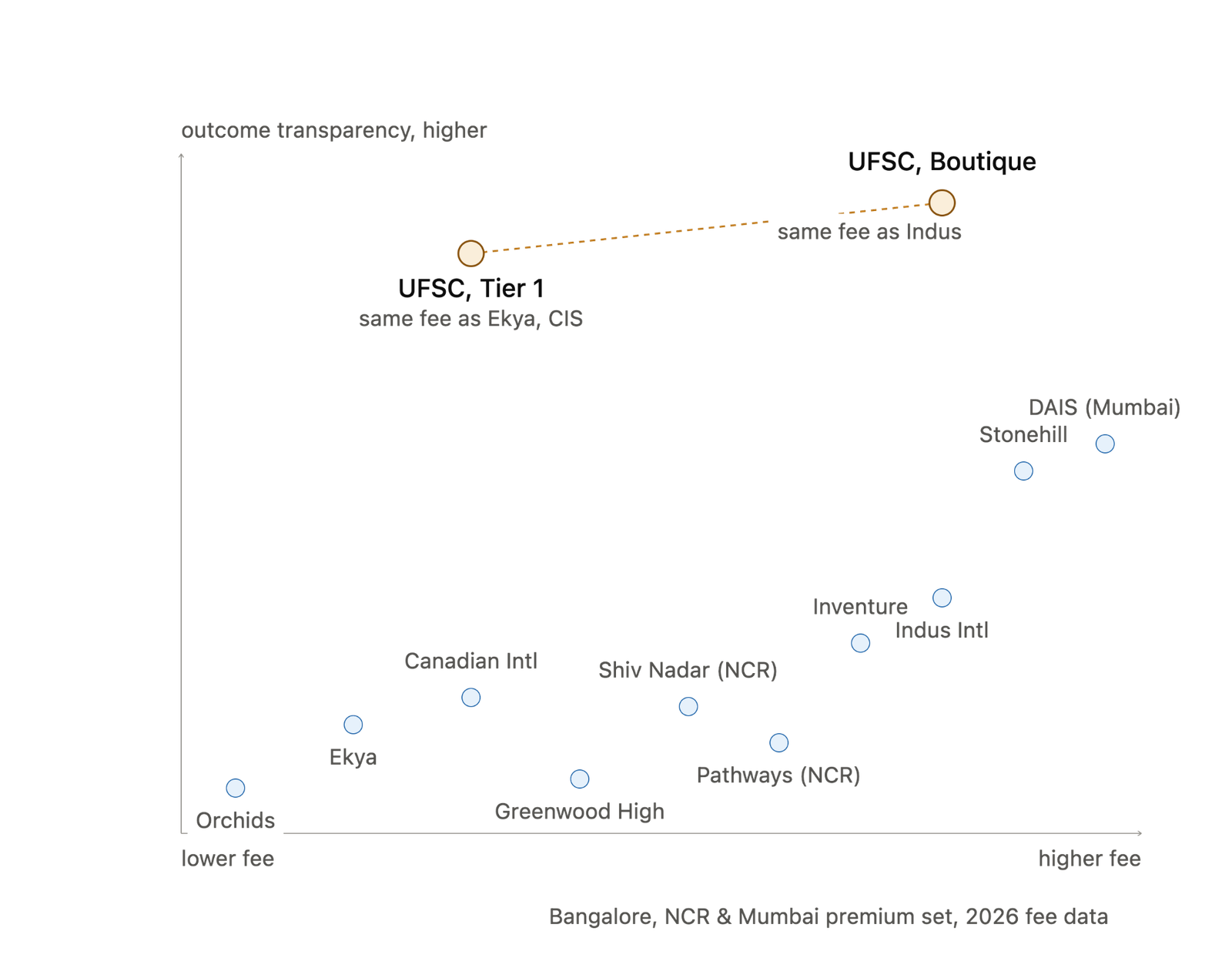
For Indian parents who are tired of choosing a school on prestige they can't verify, UFSC is the K-12 platform that shows its work — publishing what every child actually learns, every month — backed by upGrad's scale.
Slide note: This statement is deliberately combative on the "pedigree vs. evidence" axis because that's the one clean gap even the best